
ADXTÔ(Aggregated Data
Transfer Technology)
What is ADXTÔ?ADXT™ (Aggregated Data Transfer Technology) is a (patent pending) proprietary combination of hardware and software that merges the individual performance of multiple ATA drives together to achieve sustained data transfer rates typical of more expensive SCSI and Fibre Channel units.
Why ADXTÔ ?
The original notion of RAID was to build high capacity, reliable storage subsystems using large numbers of inexpensive disk drives. Thus the original definition of RAID was "Redundant Array of Inexpensive Drives". Over time that definition was morphed into "Redundant Array of Independent Drives" and the notion of an inherent cost advantage in a RAID system was lost. The ATTO Diamond Series takes disk arrays back to their "roots" by providing a high capacity, high performance and highly reliable disk array that uses the merged power of many inexpensive ATA disk drives to create these valuable attributes.
With all of the features that ATA disk drives now offer (high reliability, high speed, command overlap, queuing, etc.) it is still necessary to add a level of intelligence in the control of these drives to successfully integrate them into high performance disk storage arrays. An individual ATA disk drive is capable of providing 20 to 30MB/sec. of sustained data-transfer (reads or writes). This rate is adequate for home computer users but far too low for higher performance applications that require 80 to 180MB/sec. of sustained data-transfer rates.
ATTO Technology developed an intelligent midplane with ADXT to allow the summation or "aggregation" of the data rates from each individual ATA disk drive to create the high data transfer rates needed by SAN's and other high performance computer systems. The Diamond Series RAID Storage Arrays have data transfer rates previously available only in substantially higher priced Fibre Channel or SCSI disk arrays. The sophisticated design of the intelligent midplane also enables features such as server-less backup, advanced error protection, metadata storage techniques, virtualization software, thermal management and advanced enclosure services to be implemented in the architecture as well.
The overall architecture of the Diamond Series is comprised of dual host interface cards (HIC's), the Intelligent Midplane , system management card, redundant power and cooling assemblies and up to 12 independent dual-drive disk sleds. The data pathways and architecture are:
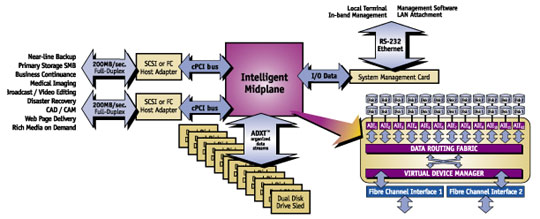
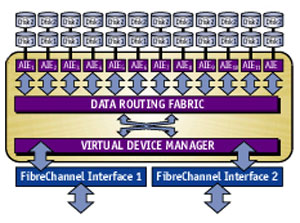
The heart of the Diamond Series RAID Storage Array is the Intelligent Midplane. It contains a combination of custom Application Specific Integrated Circuits (ASIC's), processors and proprietary embedded software to make ADXT processing technology a reality. It is divided into three main processing sections, which handle the data being read or written to the ATA disk drives via the dual host interface cards. The Virtual Device Manager (VDM), Data Routing Fabric (DRF) and ATA Interface Engines (AIE) work in concert to smoothly and efficiently organize data streams for storage or retrieval.
Schematically, ADXTÔ is illustrated as follows:
Virtual Device Manager
The Virtual Device Manager (VDM) implements virtual SCSI devices with capabilities far exceeding the abilities native to the underlying ATA disk drives. Data is accessed through the virtual SCSI devices using a rich implementation of the standard SCSI protocol. The VDM adds capabilities required by advanced storage markets such as RAID, data management services, enclosure management services, serverless backup, data replication using SCSI Extended Copy (X Copy), LUN mapping and other features which serve to increase performance, reliability, availability, and manageability.
Data Routing Fabric
Data is routed between the ATA Interface Engines (AIE) and the host interfaces by the custom Data Routing Fabric ASIC. The Data Routing Fabric is a high-speed, low-latency transfer fabric with over 2 Gb/sec of bandwidth.
ATA Interface Engine(AIE)
The interface to each pair of drives is through a custom ATA Interface Engine (AIE) ASIC. The AIE implements the typically software-intensive ATA interface completely in silicon. Each AIE contains a dedicated ATA protocol processor to completely automate command and protocol processing for maximum performance. Automated command overlapping and queuing maximizes the performance of multi-threaded I/O. The AIE transfers data using double-clocking technology, at the full speed of the ATA drives. The Diamond Series RAID Storage Array contains 12 AIE's for a parallel drive data transfer rate of 792 MB/sec. In addition to guaranteeing data-transfer integrity with automatic CRC checking, the command and status transfers are validated using a patent pending technology unique to the AIE.